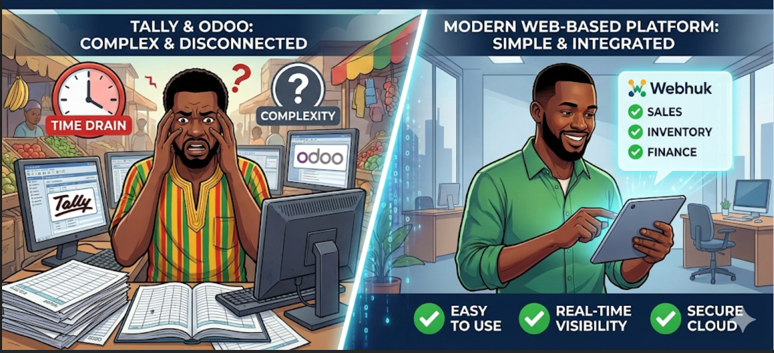
If you walk into any medium-sized manufacturing office in Tema or a busy trading house in Accra, you are likely to hear two names: Tally and Odoo. For years, these have been the "default" choices for businesses looking to move beyond simple paper ledgers.
But as we enter 2026, a quiet frustration is brewing among Ghanaian business owners. While Tally and Odoo are global giants, they were not built with the specific heartbeat of the West African SME in mind. The "hidden costs" of using software that doesn't fit your local workflow are beginning to show.
In this guide, we’ll dive deep into why these legacy systems often fail local traders and why a new wave of localized, "no-bloat" ERPs—led by Webhuk—is becoming the preferred choice for Ghana’s industrial revolution.
1- The "Tally Trap": Powerful, but Frozen in the Past
Tally (especially Tally Prime) has been a staple for accountants globally. It is powerful, yes, but for the average Ghanaian business owner who isn't a trained chartered accountant, it can feel like a labyrinth.
The Complexity Barrier: Tally is famous for its "no-mouse" interface. It relies heavily on keyboard shortcuts and a logic that made sense in the 1990s. For a modern Ghanaian trader who wants to check their stock on a smartphone while at a lunch meeting in East Legon, Tally feels like a dinosaur. It is often restricted to a local server, making remote access a technical nightmare.
The Multi-Currency Struggle: While Tally supports multi-currency, setting it up for the specific volatility of the Cedi against the Dollar or the Euro requires significant technical tweaking. For traders who need to see their real-time profit margins daily, Tally’s reports often feel too "back-dated."
2- The "Odoo Overkill": The Price of Complexity
On the other end of the spectrum is Odoo. It is modern, sleek, and modular. However, for most Ghanaian manufacturers, Odoo is often "too much software for too much money."
The Implementation Nightmare: Odoo is famous for long, expensive implementation cycles. You might start with a "free" version, but by the time you add the modules you actually need—like Manufacturing, Inventory, and GRA-compliant Accounting—the costs skyrocket. Most SMEs in Ghana don't have $10,000 and six months to spend on a software rollout.
The Lack of Local Nuance: Odoo is a global platform. It doesn't "know" what a GETFund levy is. It doesn't automatically understand the specific breakdown of Ghanaian tax laws without expensive third-party plugins. You end up paying for a Ferrari when all you needed was a reliable truck that knows the local roads.
3- The Local Alternative: Why "No-Bloat" Matters
This is where Webhuk enters the frame. Unlike Tally and Odoo, Webhuk was reimagined from the ground up to solve the specific pain points of West African manufacturers and traders.
Webhuk focuses on the "Essential 80%": Most businesses only use about 20% of an ERP's features. Instead of overwhelming you with a million buttons you'll never press, Webhuk prioritizes the workflow that actually brings in money:
- Sales & Purchase Enquiries: Most global ERPs skip the "Enquiry" stage. Webhuk knows that in Ghana, trade starts with a conversation and an enquiry.
- Vendor RFQs with Links: Why spend all day on WhatsApp? Send a link to your suppliers, let them bid, and let the system choose the best price. Neither Tally nor Odoo offers this level of simplified procurement out of the box.
4- GRA Compliance: The Local "Deal-Breaker"
As we discussed in our previous guide on GRA compliance, the Ghana Revenue Authority is now strictly enforcing E-VAT.
Tally and Odoo require significant, often buggy, customizations to meet these standards. Webhuk is natively GRA-compliant. This means the moment you set it up, your VAT, NHIL, and GETFund calculations are correct. You aren't "hacking" a global software to fit Ghana; you are using a system built for Ghana.
5- Speed of Decision: The Dashboard Advantage
In the trading world, the person with the fastest information wins. If you have to wait for your accountant to "sync" the Tally data at the end of the week, you’ve already lost three days of trading opportunities.
Webhuk’s Real-time Ratio Analysis and Cashflow dashboards give you a pulse on your business at 10:00 AM every morning. You can see:
- Which customers owe you money (Outstanding Invoices).
- Which stock items are moving slowest (Dead Stock).
- Your exact cash position across multiple currencies.
6- The 7-Day Implementation: A Reality Check
The biggest reason businesses stay with "Excel Chaos" is the fear of a long transition. Tally requires a specialist to set up your Chart of Accounts. Odoo requires a consultant.
Webhuk’s 7-Day Challenge is a direct response to this. Because the "bloat" has been removed, the setup is intuitive. Most Ghanaian traders can move their entire operation—from inventory to invoicing—in a single week.
Conclusion: Choosing the Right Tool for the Job
If you are a global multi-billion dollar corporation, Odoo might be for you. If you are a traditional accounting firm with 30 years of history, Tally might be your comfort zone.
But, if you are a growing Ghanaian manufacturer or trader who needs to stay GRA-compliant, manage stock across multiple branches, and see your profits in real-time without spending a fortune, then you need a modern alternative.
Don't let legacy software hold back your 2026 growth. It's time to choose a partner that understands the Cedi, the GRA, and the hustle of the Ghanaian market.
Frequently Asked Questions (FAQs)
Q1: Is Webhuk as powerful as Tally for accounting? Yes. Webhuk handles all core accounting functions (Ledgers, Journals, Trial Balance, P&L, Balance Sheet) but with a much more modern, user-friendly interface that doesn't require "shortcut" training.
Q2: Can I migrate my data from Tally to Webhuk? Absolutely. Most businesses find it very easy to export their current ledgers and stock lists into Webhuk to get started immediately.
Q3: How does Webhuk’s pricing compare to Odoo? Webhuk is significantly more affordable for SMEs because you don't pay for "hidden" modules or expensive implementation consultants. Our pricing is transparent and built for growing teams.
Q4: Does Webhuk work on mobile? Yes. Unlike older versions of Tally, Webhuk is cloud-native. You can access your dashboard, create invoices, and check stock from any smartphone or tablet.
Q5: Can Webhuk handle manufacturing raw materials? Yes. Webhuk includes a Resource Planning module specifically designed to track the conversion of raw materials into finished goods, something many basic accounting tools cannot do.