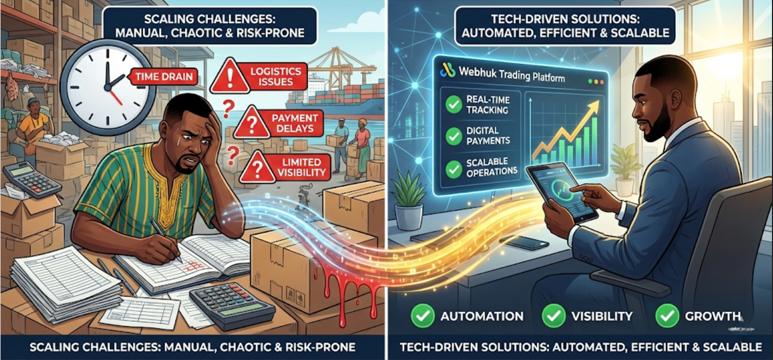
Scaling a business in the West African market—whether you are moving from a single shop in Accra to five across Ghana, or expanding from Kumasi into the wider ECOWAS region—is a feat of endurance. The opportunities are massive, but the "growing pains" can be fatal if your systems aren't ready.
As a business head, you quickly realize that what worked when you were a team of five no longer works when you are a team of fifty. Here are the five most common challenges of scaling a trading or manufacturing business in West Africa and how modern technology provides the solution.
1. Fragmented Inventory Across Multiple Locations
When you have one warehouse, you know where everything is. When you have three warehouses in Tema, Kumasi, and Takoradi, "knowing" becomes "guessing."
- The Challenge: Stock gets "lost" in the system. One branch is overstocked while another is turning away customers.
- The Tech Fix: A Cloud-Based Inventory System. With Webhuk, every branch is connected to a central brain. You can see real-time stock levels across all locations. If Accra is low on a specific raw material, you can authorize a stock transfer from Kumasi with a single click, ensuring your capital isn't sitting idle in one city while sales are being lost in another.
2. The Delegation Dilemma (Losing Control)
Most African SMEs are "owner-driven." The owner is the only one who knows the prices, the suppliers, and the bank balance. To scale, you must delegate, but delegation often leads to "leaks" or unauthorized discounts.
- The Challenge: How do you empower staff to make sales without losing control over your margins?
- The Tech Fix: User Permissions & Approval Workflows. Webhuk allows you to set specific roles. Your sales team can create quotes, but they cannot give a discount above 10% without a digital "Approval Request" hitting your phone. You keep the final say on high-level decisions while letting your team handle the daily hustle.
3. Cross-Border Compliance and ECOWAS Trade
Expanding into neighboring countries like Nigeria, Ivory Coast, or Togo introduces a new layer of complexity: different taxes and different regulations.
- The Challenge: Managing diverse tax requirements (like the GRA in Ghana vs. FIRS in Nigeria) while maintaining a consolidated view of the business.
- The Tech Fix: Multi-Jurisdiction Tax Engines. A scalable ERP isn't just local; it’s adaptable. Webhuk is built to handle multiple tax structures, ensuring that your branch in Lagos remains as compliant as your headquarters in Accra, all within the same platform.
4. Communication Breakdown in the Supply Chain
As you scale, the number of vendors and customers grows exponentially. Relying on phone calls and WhatsApp to manage procurement becomes a recipe for disaster.
- The Challenge: Procurement becomes slow and opaque. You lose track of who gave the best price for raw materials three months ago.
- The Tech Fix: Tradeboard & Vendor Links. As discussed in our Procurement Guide, using digital RFQ links allows you to manage 100 suppliers as easily as you managed 5. It builds a digital history of your trade, giving you the data needed to negotiate bulk discounts as you grow.
5. Cashflow Visibility at Scale
In a small business, you can "feel" the cashflow. In a scaling business, the numbers become too big for "gut feelings."
- The Challenge: High turnover can mask low profitability. You might be selling millions of Cedis worth of goods but losing money on every sale due to overheads you can't see.
- The Tech Fix: Real-Time Ratio Analysis. Scaling requires "Safe Growth." By monitoring your Quick Ratio and Net Profit Margins in real-time on your Webhuk dashboard, you can see if your expansion is healthy or if you are growing too fast for your cash reserves to handle.
Conclusion: Systemize Before You Scale
Scaling without a system is like building a skyscraper on sand—eventually, the weight will cause the foundation to crack. The most successful traders in West Africa aren't just the hardest workers; they are the ones who build "engines" that run without them.
By adopting a localized, scalable ERP like Webhuk, you are giving your business the foundation it needs to grow from a local success into a regional powerhouse.
Frequently Asked Questions (FAQs)
Q1: Can I add new branches to Webhuk as I expand? Yes. Webhuk is designed to scale with you. Adding a new warehouse or a new retail branch is simple and ensures all your data remains centralized.
Q2: How does the system handle different currencies for cross-border trade? Our multi-currency module allows you to trade in any currency (NGN, CFA, USD) while converting everything back to your base currency (GHS) for consolidated financial reporting.
Q3: Is the software fast enough for multiple users across different cities? Absolutely. We use high-performance cloud servers to ensure that whether you have 5 users in Accra or 50 users across three countries, the system remains fast and responsive.
Q4: Does Webhuk provide training for my new branch staff? We offer extensive documentation, video tutorials, and local support to ensure that as you hire new team members, they can get up to speed on the system quickly.
Q5: Can I see a consolidated Profit & Loss statement for all my branches combined? Yes. You can view reports for individual branches or see a "Group View" that shows the total health of your entire business empire at a glance.