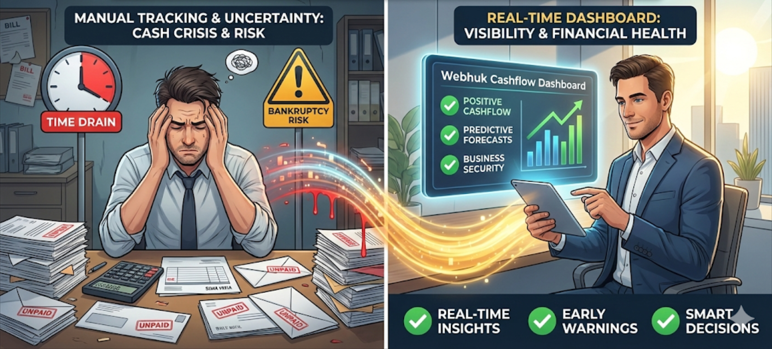
There is an old saying in the industrial estates of Accra and Tema: "Profit is a theory, but Cash is a fact."
You can have a manufacturing plant running at 100% capacity. You can have a sales book full of orders. You can even show a "paper profit" at the end of the quarter. But if your bank account is empty when it’s time to pay your staff or buy raw materials, your business is in grave danger. In the volatile economy of 2026, many Ghanaian SMEs fail not because they lack customers, but because they lose control of their cashflow.
The solution isn't just "more sales"—it’s Real-Time Financial Visibility. ###
1. The Danger of the "Accounting Lag"
Traditionally, an SME owner in Ghana waits until the end of the month for their accountant to "balance the books." By the time you receive your Profit & Loss statement on the 10th of the following month, you are looking at a "post-mortem" of the past. If you spent too much on overheads in week one, you only find out four weeks later.
A real-time ERP dashboard eliminates this lag. Every time an invoice is paid or a purchase is recorded, your dashboard updates instantly. You aren't managing your business based on what happened last month; you are managing it based on what is happening this morning.
2. Profit vs. Cashflow: Understanding the Gap
This is the most common trap for growing traders. You sell 100,000 GHS worth of goods on credit. Your "Profit" looks great. But if your suppliers demand payment in 7 days and your customers pay you in 60 days, you have a cashflow gap.
Webhuk’s dashboard highlights your Aging Receivables (who owes you money and for how long). By seeing this at a glance, you can:
- Identify "problem" customers before they hit their credit limit.
- Prioritize collection calls to bring cash into the business.
- Negotiate better terms with vendors based on your actual liquidity.
3. Beyond the Basics: The Power of Ratio Analysis
Most basic accounting software gives you a P&L and a Balance Sheet. But very few give you Ratio Analysis—a feature usually reserved for expensive enterprise systems.
Webhuk brings this "Big Data" power to the Ghanaian SME. Two ratios, in particular, can save your business:
- The Current Ratio: This measures your ability to pay short-term obligations. If this ratio drops too low, the dashboard flags it as a risk.
- The Quick Ratio (Acid Test): This tells you if you can survive a crisis using only your most liquid assets (cash and receivables), excluding inventory that might be hard to sell quickly.
Understanding these numbers allows you to make "Safe Growth" decisions. Can you afford that new machine? Should you hire three more staff members? Your ratio analysis gives you a "Yes" or "No" based on mathematical reality, not gut feeling.
4. Tracking "Leaks" in Real-Time
In a manual system, small leaks—like minor inventory theft, unrecorded expenses, or missed VAT credits—go unnoticed until they become a flood. When your procurement is linked to your cashflow, every cedi is tracked. Webhuk’s Omnichannel Commerce and Tradeboard features ensure that every expense has a digital footprint. If your "Cost of Goods Sold" (COGS) suddenly spikes, you’ll see it on your dashboard today, allowing you to investigate the warehouse or renegotiate with your vendor immediately.
5. Multi-Currency Cashflow: A Strategic View
As we discussed in our Multi-Currency Survival Guide, your cashflow isn't just about the total amount; it’s about the currency mix. A real-time dashboard shows you exactly how much USD vs. GHS you have. If you have a large USD payment due to a supplier next week, but 90% of your cash is in Cedis, your dashboard warns you of the "Forex Risk." This allows you to secure your foreign exchange early, potentially saving thousands in rate fluctuations.
6. Transparency for Banks and Investors
If you ever plan to take a business loan from a Ghanaian bank or attract an investor, the first thing they will ask for is your financial history. Presenting a clean, real-time dashboard with accurate ratios and transparent cashflow history makes you an "A-Grade" borrower. It proves that you aren't just a "hustler"—you are a Systemized Business Leader.
Conclusion: Knowledge is Your Best Insurance
Bankruptcy rarely happens overnight. It is usually the result of a hundred small, invisible financial mistakes. A real-time cashflow dashboard acts as an "Early Warning System" for your business.
By adopting Webhuk’s modern dashboard and ratio analysis, you are giving yourself the ultimate competitive advantage: Certainty. You will know exactly where your money is, who has it, and how much you need to reach the next level of growth.
Frequently Asked Questions (FAQs)
Q1: Do I need to be an accountant to understand the Ratio Analysis? Not at all. Webhuk’s dashboard uses simple "Traffic Light" indicators (Red, Amber, Green) to show the health of your ratios. We provide the complex math in the background so you can focus on the results.
Q2: Can I access my financial dashboard from my phone? Yes. Because Webhuk is cloud-native, you can check your cashflow, P&L, and ratio analysis from any smartphone while you are on the move.
Q3: How often does the dashboard update? Instantly. As soon as a transaction (like an invoice payment or a purchase) is recorded in the system, the dashboard and all financial ratios reflect the change.
Q4: Can the system help me predict future cashflow? By looking at your "Aging Receivables" and your "Scheduled Payables," Webhuk gives you a clear view of your expected cash position for the next 30 to 60 days.
Q5: Is this feature included in the standard Webhuk package? Yes. We believe that real-time financial visibility is a right, not a luxury, for every growing SME.