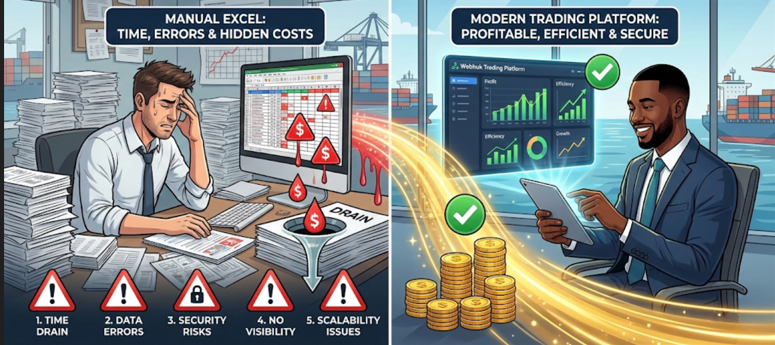
Walk into any warehouse in the Tema Industrial Zone or any large wholesale shop in the heart of Accra, and you will likely find a computer running Microsoft Excel. For years, Excel has been the "digital backbone" of Ghanaian SMEs. It’s familiar, it’s flexible, and most importantly, it feels "free."
But as we compete in the high-speed market of 2026, many traders are beginning to realize that Excel is no longer a tool for growth—it’s a leaky bucket. Every time a row is accidentally deleted, every time a price is entered incorrectly, and every time a stock count doesn't match the physical reality, your business loses money.
Here are the five hidden costs of relying on Excel that are silently killing your profits.
1- The "Human Error" Tax
Excel is only as good as the person typing into it. In the fast-paced environment of a manufacturing plant or a busy trade hub, fatigue leads to mistakes. A misplaced decimal point can turn a 1,000 GHS sale into a 10,000 GHS error—or worse, a 100 GHS loss.
Unlike an ERP, Excel has no "guardrails." It won't warn you if you're selling stock you don't have, or if the discount you just gave a customer puts you below your cost price. With a professional ERP like Webhuk, these rules are automated. The system prevents errors before they hit your bottom line.
2- The Cost of "Ghost Stock" and Stockouts
When you manage inventory on a spreadsheet, the data is always "backwards-looking." You are recording what happened yesterday or this morning. Meanwhile, in the real world, a customer just bought the last 50 bags of cement, but your Excel still shows them as available.
This leads to two profit-killers:
- Stockouts: You promise a customer an item, realize you don't have it, and lose the sale (and the customer's trust).
- Overstocking: You buy more of an item you think is low, only to find three pallets hidden at the back of the warehouse. Your capital is now "trapped" in stock that isn't moving.
3- The "GRA Audit" Risk
As we’ve discussed in our guide to GRA compliance, the Ghana Revenue Authority is moving toward real-time digital monitoring. Excel is an "offline" tool. It doesn't generate QR codes, it doesn't track VAT/NHIL/GETFund breakdowns automatically, and it doesn't provide an immutable audit trail.
If the GRA auditors visit your office in Tema and see you are running your multi-million Cedi business on a spreadsheet, it’s an immediate red flag. The time and money spent fixing tax discrepancies caused by "Excel mess" often cost ten times more than an annual ERP subscription.
4- Fragmented Communication (The WhatsApp-Excel Loop)
In most Ghanaian trading businesses, the workflow looks like this:
- Customer sends a WhatsApp message.
- Salesperson checks the Excel file.
- Salesperson calls the warehouse to confirm.
- Warehouse confirms, salesperson types a quote in Word.
- Finally, an invoice is made.
This "loop" is incredibly slow. Every step is an opportunity for information to get lost. A modern system replaces this with a Tradeboard. When an enquiry comes in, the sales team can see real-time stock levels immediately. They convert the enquiry into a quote in one click. No phone calls, no WhatsApp back-and-forth, just speed.
5- Lack of Real-Time "Ratio Analysis"
Most Excel-based businesses only know if they are truly profitable at the end of the month (or year) when the accountant finishes the books. By then, it’s too late to fix a bad month.
Because an ERP like Webhuk tracks every cedi in real-time, you get Ratio Analysis instantly. You can see your Gross Profit Margin, your Debt-to-Equity ratio, and your Current Ratio at any given moment. If your margins are shrinking in week two, you can adjust your prices in week three—Excel doesn't give you that foresight.
The Verdict: It's Time to Graduate
Excel is a great calculator, but it is a terrible business manager. For a small shop starting out, it’s fine. But if you are a manufacturer in Tema or a trader with multiple branches, you have outgrown the spreadsheet.
The switch to a "No-Bloat" ERP isn't about buying a complex software; it's about plugging the leaks in your profit. It’s about knowing that every invoice is correct, every tax is paid, and every item of stock is accounted for.
Conclusion: Future-Proof Your Profit
The most successful businesses in the Tema Industrial Zone are moving away from manual processes. They are embracing automation to ensure they can scale without their "system" breaking. Don't let a spreadsheet be the ceiling on your business growth.
Frequently Asked Questions (FAQs)
Q1: Is it hard to move my existing Excel data into Webhuk? Not at all. We provide easy-to-use import templates. You can upload your customer lists, vendor details, and current stock levels from Excel into Webhuk in minutes.
Q2: Will my staff be able to learn a new system if they are used to Excel? Webhuk is designed with an "Intuitive Workflow." If your staff can use a smartphone and fill out a basic form, they can use Webhuk. It’s actually simpler than maintaining complex Excel formulas.
Q3: Can I still export reports to Excel if I need to? Yes! We know people still love Excel for custom analysis. You can export any report (Sales, P&L, Inventory) from Webhuk back into Excel whenever you want.
Q4: How does Webhuk help with the "Input-Output" VAT gap? Unlike Excel, Webhuk tracks the VAT you pay to suppliers (Input) and the VAT you collect from customers (Output) automatically, giving you a clear view of your net tax position at all times.
Q5: What is the biggest difference between a spreadsheet and Webhuk for inventory? Real-time syncing. When a sale is made in your Accra shop, the stock is instantly deducted from the system, and your warehouse manager in Tema sees the update immediately.