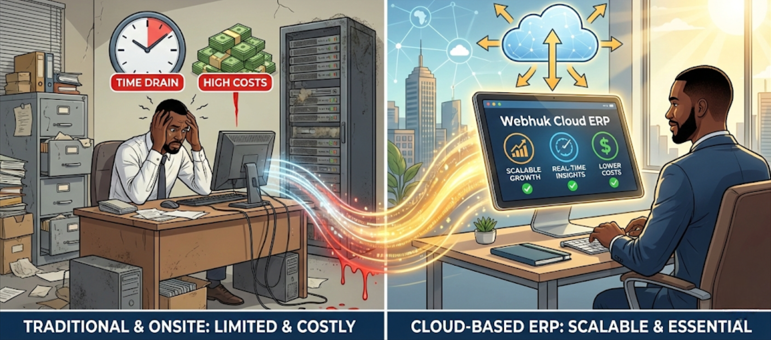
We are living through a historic transformation in how business is done across West Africa. In 2026, the industrial landscape of Ghana, Nigeria, and beyond is no longer defined by who has the largest physical office, but by who has the most efficient digital system.
For years, the phrase "digital transformation" sounded like a buzzword reserved for large corporations in Europe or Asia. But today, for the SME manufacturer in Kumasi or the wholesaler in Tema, it has become a matter of survival. The move from on-premise, paper-based, or spreadsheet-driven operations to a Cloud-Based ERP is the single most important decision you can make to future-proof your business.
Here is why the cloud is the only way forward for the modern African entrepreneur.
1. Resilience Against "Infrastructure Friction"
Traditional software requires a local server. A local server requires constant electricity, cooling, and physical security. In West Africa, where power surges (dumsor) and hardware maintenance are daily challenges, relying on a physical box in your office is risky.
- The Cloud Advantage: Webhuk lives on enterprise-grade servers with 99.9% uptime. If your office loses power, your data is safe. If your office laptop is stolen, your business doesn't stop. You simply log in from a new device and keep moving. Your business remains "always on," even when your physical infrastructure is facing challenges.
2. Real-Time Compliance in a Digital Economy
As we’ve explored in our GRA Compliance Guide, tax authorities are no longer accepting manual excuses. The digitalization of the Ghana Revenue Authority means that compliance is now a technical requirement.
- The Cloud Advantage: Cloud systems are updated instantly. When the GRA changes a tax rate or introduces a new digital invoice format, you don't need to "reinstall" your software. The cloud updates for you. Your business stays compliant with the latest laws automatically, shielding you from penalties that could cripple an SME.
3. Mobility: The New CEO Standard
The most successful CEOs in 2026 aren't tied to a desk. They are on the ground—visiting clients, negotiating with suppliers at the port, or attending trade fairs in Abidjan.
- The Cloud Advantage: A cloud-based ERP is your "Business in a Pocket." Whether you are at home, at a meeting, or traveling internationally, you have total visibility. You can approve a high-value quote, check your cashflow, or track a stock transfer from your smartphone. Mobility is no longer a luxury; it’s a competitive requirement.
4. Scalability Without the "Growth Pain"
One of the hardest parts of scaling a business is the technical barrier. In the old days, opening a new branch meant setting up a new server and trying to "sync" the data at the end of the day.
- The Cloud Advantage: With Webhuk, adding a new branch is as simple as adding a new user. Your second, third, or tenth location is instantly connected to your headquarters. Your inventory, sales, and accounting are consolidated automatically. The cloud allows you to scale at the speed of your ambition, not the speed of your IT department.
5. Data-Driven Decision Making
In a low-tech business, you make decisions based on "gut feeling." You think you're profitable; you hope you have enough stock.
- The Cloud Advantage: The cloud turns your daily activity into data. With Real-Time Ratio Analysis and cashflow dashboards, you make decisions based on facts. You know exactly which products have the highest margins and which customers are the most valuable. This clarity allows you to out-maneuver competitors who are still guessing.
6. Security and Disaster Recovery
For many SMEs, the most valuable asset they own is their data (customer lists, pricing history, financial records). Losing that data to a virus, a fire, or a disgruntled employee is a death sentence for a business.
- The Cloud Advantage: Professional cloud ERPs use bank-level encryption and automatic backups. Your data is guarded by security experts whose only job is to protect information. This level of security is impossible to achieve with a local server or an Excel file.
Conclusion: The Choice is Yours
The 2026 market doesn't wait for those who are "still thinking about it." The gap between the systemized, cloud-enabled business and the manual, paper-based business is widening every day.
Future-proofing your business isn't about buying the most expensive technology; it's about choosing the right technology. It's about building your business on a "No-Bloat," localized foundation that understands your market and grows with your vision.
Don't let your business be a relic of the past. Embrace the cloud, take the Webhuk 7-Day Challenge, and step into the future of African trade.
Frequently Asked Questions (FAQs)
Q1: Is cloud software more expensive than traditional software? In the long run, it is significantly cheaper. You save on hardware costs, IT maintenance, electricity, and the massive hidden cost of manual errors and tax penalties.
Q2: What happens if I want to stop using the cloud later? You always own your data. Most cloud providers, including Webhuk, allow you to export your data into formats like Excel or CSV whenever you need to.
Q3: Is the cloud secure from hackers? Yes. Webhuk uses industry-standard encryption protocols. In fact, your data is much safer in a secure cloud environment than on a local office computer which can be physically accessed or infected by local malware.
Q4: How much internet data does an ERP use? Very little. Modern cloud ERPs are optimized to be "lightweight." Using Webhuk for a full day of work often uses less data than watching a single YouTube video.
Q5: Can I use Webhuk if my team is not tech-savvy? Yes. We designed the interface to be "Intuitive." If they can use WhatsApp or a mobile banking app, they can use Webhuk. Our goal is to make the software invisible so you can focus on your business.